
If you run a small or medium-sized business, you probably know the feeling. Marketing should be bringing in leads. Sales should be smoother. Growth should feel predictable.
But instead, it often looks like this: a social post here. A Google ad there. A “quick update” to the website whenever you remember. Maybe you try email sometimes, but you never quite know what to send or who you’re targeting.
It’s busy. It feels productive. And yet results are inconsistent, expensive, and hard to measure.
That is exactly what we call Random Acts of Marketing.
And in 2026, random marketing is going to feel even more painful because the market will keep moving faster, attention will keep getting more expensive, and buyers will keep demanding relevance.
The good news? You do not need more tactics. You need a system that connects tactics together.
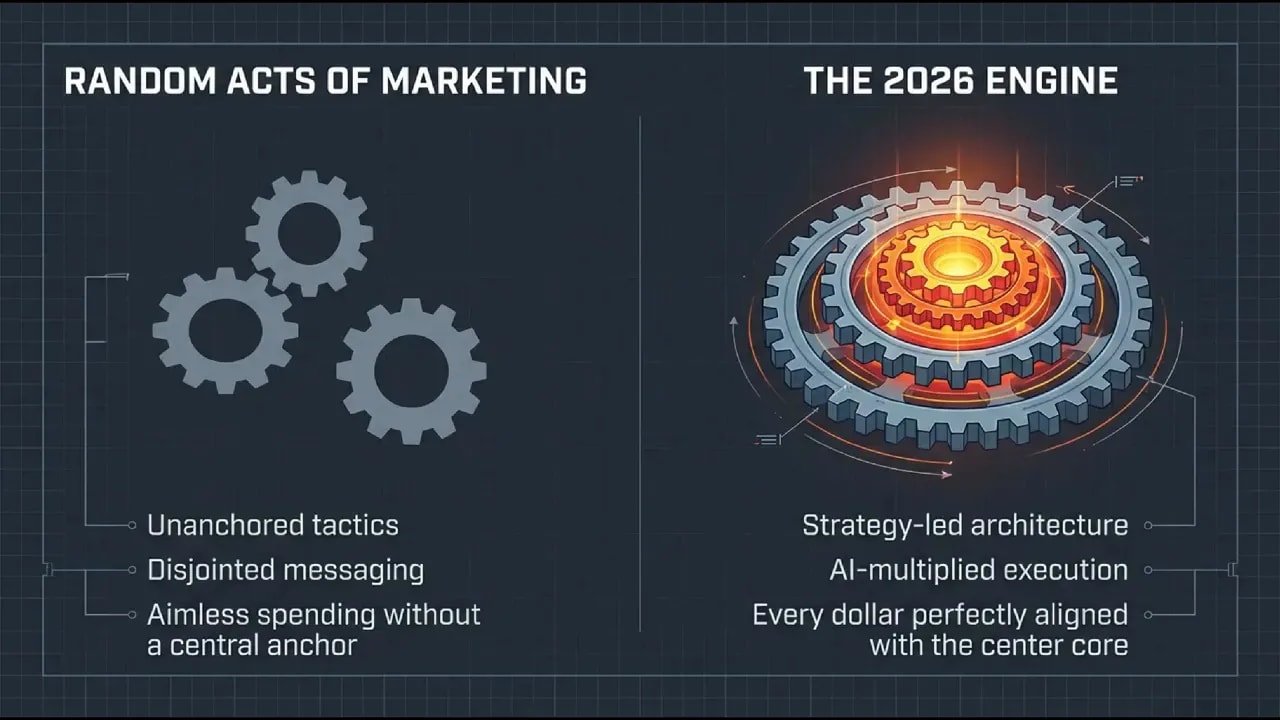
Let’s talk about a practical framework called The 2026 Marketing Engine. It is a modern, strategy-led system designed for real, measurable growth. And it is built around four core components that work like a machine, not a pile of disconnected marketing chores.
Table of Contents
- 🚫 Random Acts of Marketing vs. The 2026 Engine
- ⚙️ The 4 Components of a High-Performance System
- 🧠 The Strategy Core: The Anchor of Your Marketing Engine
- 🏗️ Ring 1: The Fractional CMO (The Architect)
- 🤖 Ring 2: The Engine Room (Human + AI)
- 🧩 Ring 3: Modernized Tactics for 2026
- 🏁 The Engine in Motion: The 2026 Operational Flow
- 📌 The Bottom Line (and the Real Question)
- ✅ FAQ
- 🚀 Ready to Build Your 2026 Marketing Engine?
🚫 Random Acts of Marketing vs. The 2026 Engine
Most SMB marketing fails for a simple reason: there is no shared logic holding everything together.
One tactic is chosen because it sounds trendy. Another is added because someone you trust suggested it. Another appears because you feel behind. And every time something underperforms, the response is usually more random changes.
That is the core issue.
Marketing becomes a set of disconnected actions rather than a connected growth process. The outcome is predictable:
- Time gets wasted because you are constantly reinventing what you should do next.
- Budget gets burned on tactics that cannot reach their potential because the foundation is missing.
- Growth stays inconsistent because there is no compounding system at work.
The 2026 Marketing Engine is different. It is fully integrated, strategy-led, and designed so that every piece reinforces the others.
Think of it like a precision machine. Each “ring” has a job. When you run the machine properly, the output gets better over time, not worse.
⚙️ The 4 Components of a High-Performance System
The Marketing Engine has four core components, working together in harmony.
At the center is The Strategy Core.
Then there are three “rings” around it:
- Ring 1: The Fractional CMO (the architect)
- Ring 2: The Engine Room (human expertise plus AI execution)
- Ring 3: The outer ring of modernized tactics (capture, search and authority, and audience nurture)
Here is the important part: this is not just about what you do. It is about how decisions get made, how work gets executed, and how results get measured.
🧠 The Strategy Core: The Anchor of Your Marketing Engine
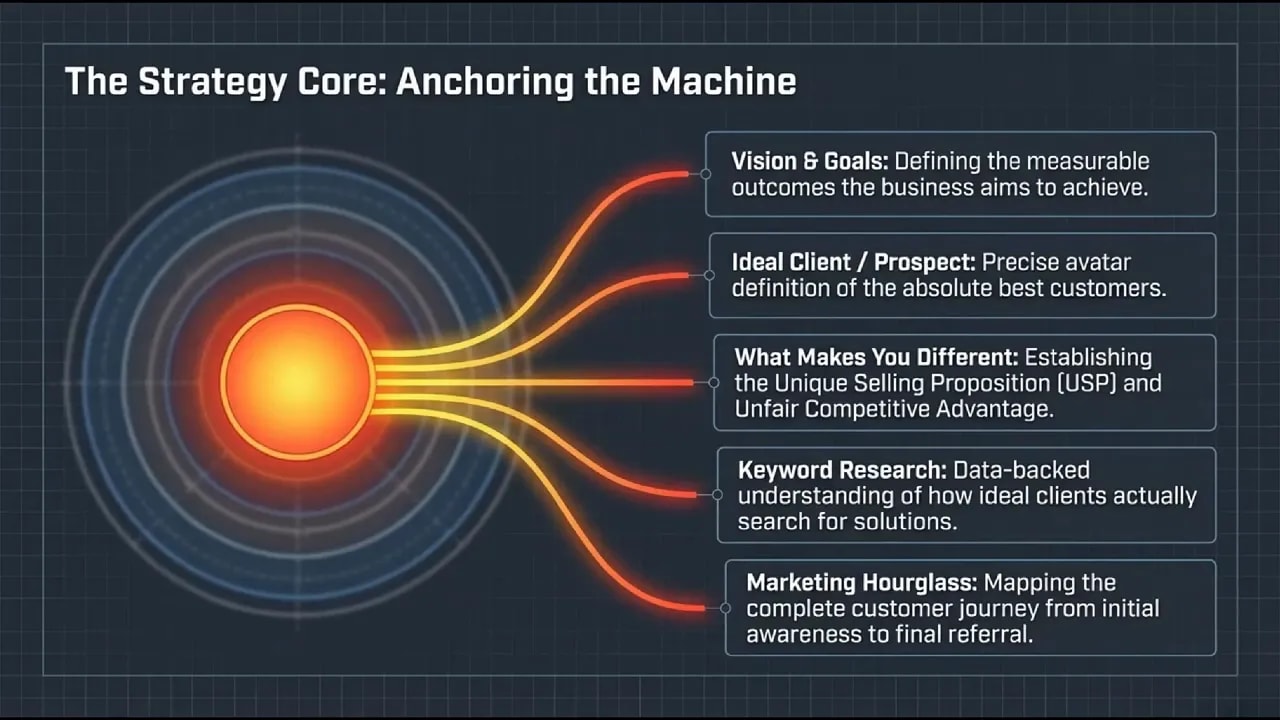
Everything starts with The Strategy Core.
This is where you define the moving parts that most businesses never fully lock down. In other words, it is the anchor for the entire machine.
In the Strategy Core, you identify:
- Your ideal client
- Your unique value proposition
- Your competitive positioning
- Your revenue goals
- Your brand messaging
Without this foundation, tactics become guesswork. A website might get traffic but not leads. An ad might generate clicks but not conversions. Email might send messages but not move prospects toward buying.
With a Strategy Core, every marketing dollar works harder and smarter because the messaging, offers, and targeting all follow the same logic.
If you want a starting point for building the strategic side of your marketing, use this as a reading list:
- How to Build an Effective Small Business Marketing Plan
- Strategy-First Blueprint
- 7 Growth Hacks to Help Small Business Soar
🏗️ Ring 1: The Fractional CMO (The Architect)
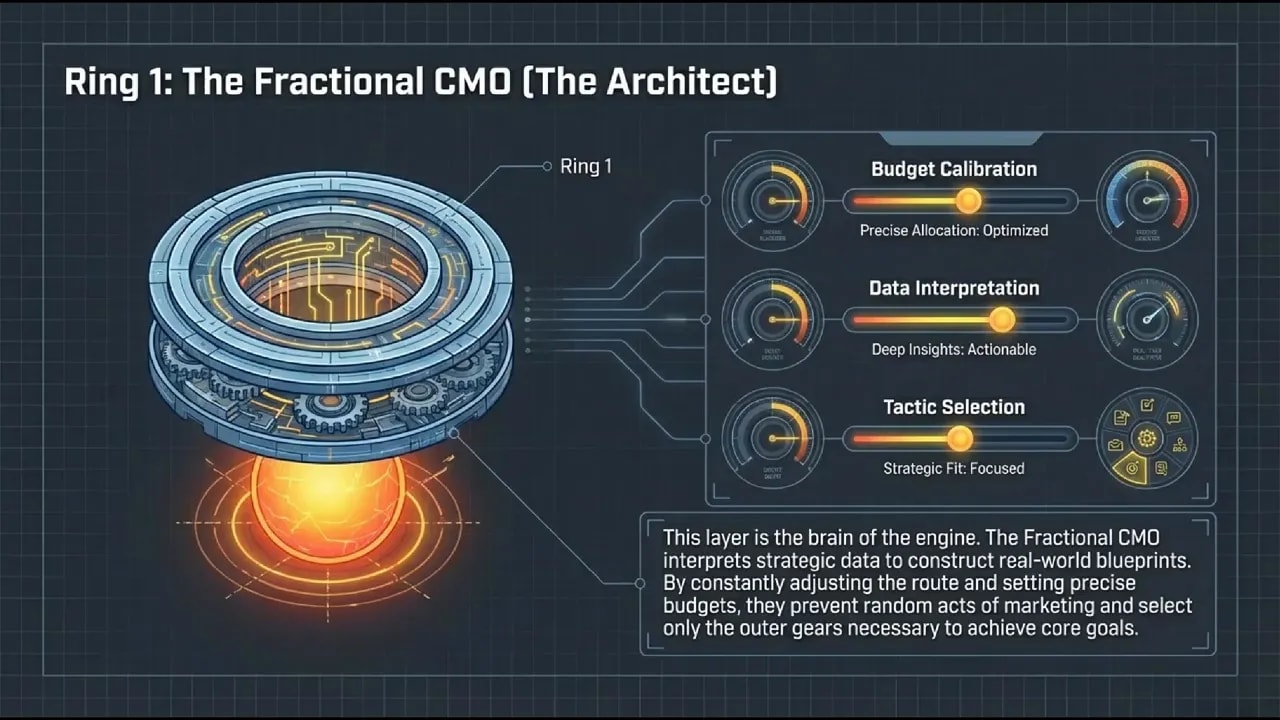
Once your Strategy Core is clear, you need someone to translate strategy into execution decisions. That is where Ring 1 comes in.
The Fractional CMO is senior marketing leadership without the full-time cost.
In practical terms, the Fractional CMO calibrates your budget, interprets your data, and selects the right tactics for your current stage of growth.
It is the “architect” role. The job is to make sure your engine stays aligned and keeps producing output that leads to revenue, not just activity.
Why does this matter so much for SMBs?
Because most small teams do not have time for strategic analysis and performance review cycles. When there is no leadership layer doing that work, marketing becomes reactive. You chase what is loud, not what is effective.
When the architect is in place, you get:
- Budget calibration so spending matches priorities
- Data interpretation so decisions are based on reality
- Tactic selection so you invest in what fits your stage
- Performance calibration so your engine stays “running”
🤖 Ring 2: The Engine Room (Human + AI)
Ring 2 is where the system becomes real.
This is called The Engine Room, and it is made up of your human team plus a trained AI platform, working side by side.
Here is the philosophy: you do not replace humans. You accelerate what humans do best.
Your team brings:
- Creativity
- Relationships
- Judgment
The AI brings:
- Speed
- Scale
- Consistency
Together, the Engine Room creates more output at higher quality than either could produce alone.
This is one reason the 2026 Marketing Engine is positioned as “AI-enhanced execution.” But it is not AI for the sake of AI. It is AI used as leverage, so the engine can move faster without losing coherence.
If you are looking for practical ways to use AI in a business context, start with:
🧩 Ring 3: Modernized Tactics for 2026
The outer ring holds your tactics. But in the Marketing Engine, tactics do not sit alone like isolated campaigns.
They are fully powered by your AI platform and designed to work together.
Most SMBs keep using tactics that were built for a different era. In 2026, that approach will start to feel like trying to win with last decade’s tools.
So the engine uses an updated “tactical gear grid.” Under each category, the point is not just to do something. It is to do something that supports the next stage of the journey.
🎯 Capture and Convert
This part of the engine focuses on getting attention and turning it into leads.
In the Capture and Convert ring, you use:
- AI-optimized web experiences
- High-converting lead magnets
- Smart retargeting
Notice the logic: you attract someone, you offer them something valuable, and you follow up with relevance if they did not convert immediately.
If you want to deepen the conversion side, these reads help:
- Website Conversion: Helpful Tools
- Most Important SEO Metrics to Track
- 5 Ways to Capture More Email Leads
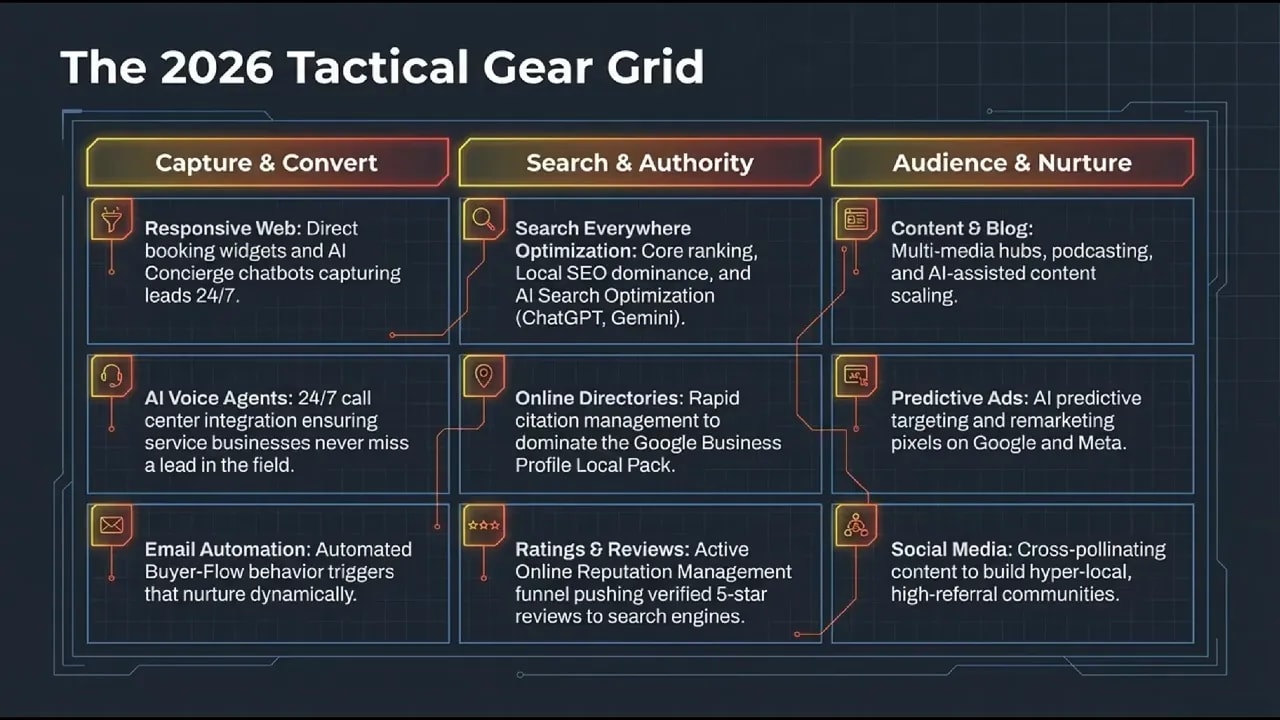
🔎 Search and Authority
Capture gets leads. Search and Authority builds the trust that makes leads more likely to convert.
In this ring, you deploy:
- SEO
- Thought leadership content
- AI-assisted PR
When these components are connected, your marketing does not rely on short-lived wins. It builds a durable presence so buyers can find you and feel like you are credible.
If search visibility is a priority, these resources are relevant:
- Local SEO Playbook: Guide to Local Rankings
- Most Common Digital Marketing Mistakes
- Essential Elements Your Website Must Have
📩 Audience and Nurture
Here is the part SMBs often underinvest in: nurturing.
Many prospects are not ready to buy when they first encounter your brand. They need follow-up. They need consistency. They need to feel understood.
Audience and Nurture includes:
- Email automation
- Social media
- Community building
The goal is to move prospects through your funnel with personalized touchpoints.
That means the engine stays active between campaigns. It keeps turning attention into trust.
If you want help on the email side, explore:
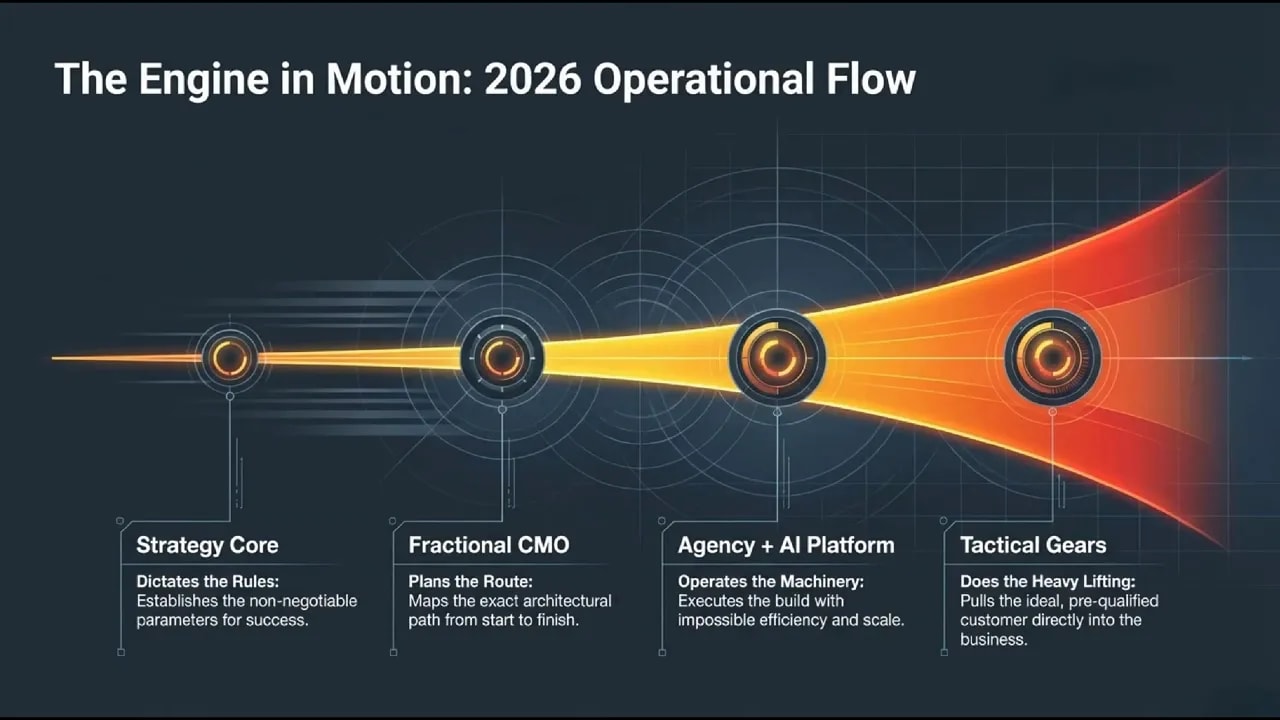
🏁 The Engine in Motion: The 2026 Operational Flow
Now you have the rings. But how does the machine actually run day to day?
The 2026 Operational Flow moves through four stages:
- Attract the right audience with targeted content and search visibility
- Capture their attention with compelling offers and lead generation
- Nurture relationships through automated, personalized touchpoints
- Convert prospects into loyal, paying customers and repeat the cycle to fuel ongoing growth
This is where the “engine” metaphor becomes useful. You are not picking random tactics and hoping something works. You are moving people through a connected process.
Stage 1: Attract
Attraction is about being visible to people who are actually relevant to you.
In the engine, that is done through targeted content and search visibility. The goal is not generic reach. The goal is attraction to the right audience.
This stage often includes:
- SEO work that improves discoverability
- thought leadership content that makes you credible
- search visibility that positions you for “problem-aware” prospects
Stage 2: Capture
Capture means you convert attention into a measurable next step.
That next step is usually a lead magnet, a consultation request, a form submission, or a similar conversion event.
In the engine, capture and convert uses AI-optimized web experiences, high-converting lead magnets, and smart retargeting to improve the odds that attention turns into lead data.
If you want an easy way to tell whether your capture stage is working, ask yourself one question:
When someone lands on your site, do they have a clear reason to take the next step?
Stage 3: Nurture
Nurture is where you earn the right to convert.
Automated, personalized touchpoints help prospects feel like you understand their situation and that you are not just pitching. This can include email automation, social media consistency, and community building.
The engine uses nurture to keep momentum without needing you to constantly create new content from scratch.
One of the most common errors is treating email like a broadcast tool only. Instead, think about nurturing like a guided conversation. Your prospects should receive relevant information that aligns with where they are in the journey.
Stage 4: Convert
Conversion is the payoff stage.
This is where you turn prospects into loyal, paying customers and then repeat the cycle.
When your engine is built correctly, conversion is not a one-time event. It is a loop that fuels ongoing growth because you have captured leads and built trust through nurture.
And once you convert customers, your marketing engine can expand beyond lead generation into retention and reputation. That makes growth more sustainable.
📌 The Bottom Line (and the Real Question)
Here is the bottom line:
In 2026, businesses that run a precise, connected marketing engine will outperform those still doing random acts of marketing.
The question is not whether you need a system.
The question is whether you are ready to build it.
If you are ready, you are probably asking what the next step looks like.
That is where Outsourced Marketing can help install, run, and scale the engine. The focus is not on random tactics. The focus is on building the connected framework that produces measurable results.
To explore more resources and deeper strategy topics, visit:
✅ FAQ
What is the “2026 Marketing Engine”?
It is a strategy-led marketing system designed for small and medium-sized businesses. It combines a central strategy foundation with three “rings” of leadership, execution, and modern tactics, all connected through an operational flow: Attract, Capture, Nurture, Convert.
Why does random marketing stop working as well?
Random acts of marketing lack a shared foundation, so tactics cannot reinforce each other. The result is wasted time and money, inconsistent lead generation, and growth that is difficult to measure or scale.
What role does the Strategy Core play?
The Strategy Core defines your ideal client, unique value proposition, competitive positioning, revenue goals, and brand messaging. It anchors all tactics so your marketing dollars work harder and smarter.
What is a fractional CMO?
A fractional CMO provides senior marketing leadership without the full-time cost. In the engine, this role calibrates budget, interprets data, and selects the right tactics based on your growth stage.
How does AI fit into the system?
AI supports execution in the Engine Room by adding speed, scale, and consistency, while your human team provides creativity, relationships, and judgment. The engine uses AI-enhanced execution to produce higher-quality output.
What tactics does the engine include?
The engine organizes tactics into a “gear grid” across Capture and Convert, Search and Authority, and Audience and Nurture. This includes AI-optimized web experiences and lead magnets, SEO and thought leadership content, and email automation and community building.
How do you measure success in this engine?
The engine is designed to be strategy-led and operational. By connecting tactics to funnel stages (Attract, Capture, Nurture, Convert), you can track whether the system is moving prospects forward and converting them into paying customers.
Where should a business start if they feel behind on marketing?
Start with the Strategy Core. Once you clarify ideal client, positioning, messaging, and revenue goals, you can build the operational flow and then layer in modern tactics that connect to each stage.
🚀 Ready to Build Your 2026 Marketing Engine?
If you want predictable, measurable growth, you need a system that compounds. Random acts of marketing will keep costing you time and money. A connected marketing engine gives you a repeatable process that moves prospects forward and fuels ongoing growth.
Start by exploring more at Outsourced Marketing Blog, and if you want help building and running the engine, reach out via:
The growth you have been working toward is closer than you think. The engine just needs to be built, installed, and run precisely.
SCHEDULE A COMPLIMENTARY STRATEGY SESSION
Ask your marketing questions, get expert answers, book your free session now!