
Most small businesses do not need more random tactics. They need a small business marketing system that improves visibility, builds trust, and follows up consistently.
If you’re great at what you do, you probably don’t understand why growth feels so stubborn.
You do the work. You deliver results. You show up on time, solve problems, and treat customers right. So why aren’t more people calling, emailing, or buying?
The issue usually isn’t your skill. It’s that potential customers:
- cannot find you in the first place,
- don’t trust you once they do, or
- forget about you after the first contact.
In 2026, those problems are even easier to miss because the way customers discover professionals has shifted again. Word of mouth is still real, but referrals are not the end of the journey anymore. Even when someone recommends you, the next step is almost always the same: they search online.
And what they find determines whether they choose you or your competitor.
Here’s the growth blueprint that ties everything together. Think of your marketing like a growth engine with three interconnected gears:
- Visibility gets you seen.
- Trust makes people believe in you.
- Follow-up keeps you top of mind.
When all three work together, you create predictable, sustainable growth. But if even one gear is missing, the engine stalls.
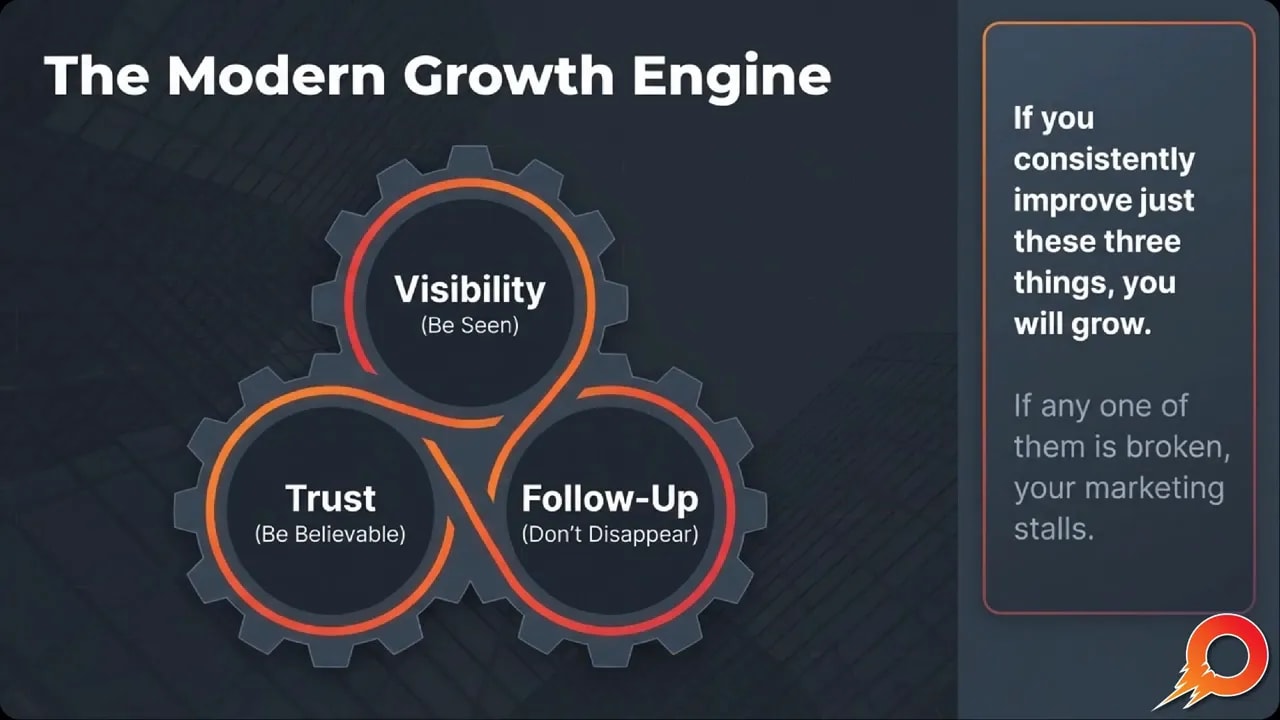
Table of Contents
- 🧠 The Real Problem: You’re Losing Customers Before They Convert
- ⚙️ The 3-Gear Growth Engine: Visibility, Trust, Follow-up
- 📍 Visibility in the Age of AI: What Google and AI Actually Look At
- ⭐ Trust Signals That Convert Browsers Into Buyers
- 📲 Follow-up: The Missing Gear That Costs You 50–70% of Sales
- 🧩 How the Flywheel Effect Works (And Why It Feels Like “Predictable Growth”)
- 🧰 How to Know If You Need This (Trigger Phrases to Listen For)
- 📊 A Practical Checklist: Quick Wins for Each Gear
- 🧠 Elevate Your Growth With Strategic Marketing (Not Random Marketing)
- 🎁 Free Visibility, Trust, and Follow-up Checkup
- ❓ FAQ
🧠 The Real Problem: You’re Losing Customers Before They Convert
Let’s get brutally honest for a moment. Most small businesses aren’t “bad at marketing.” They’re just missing the system that turns attention into revenue.
Here’s how it typically plays out:
- You put energy into networking, referrals, ads, or social media.
- A prospect hears about you.
- They search for you online to confirm details.
- If you are hard to find, look unprofessional, or lack proof, they keep searching.
- If they do contact you and you go quiet after one message, they move on.
That is the cycle. And it is expensive because you are not only paying for lead generation. You are paying in lost opportunity every time you fail at one of the three gears.
So instead of asking, “What marketing should we do next?” the smarter question is: “Which gear is broken right now?”
⚙️ The Small Business Marketing System: Visibility, Trust and Follow-Up.
A small business marketing system is a repeatable process that helps people find you, trust you, and hear from you again until they are ready to buy.
Good marketing today is less about “hustling” and more about building a reliable customer experience that starts before the first conversation and continues after it.
1) Visibility: Can People Find You Online?
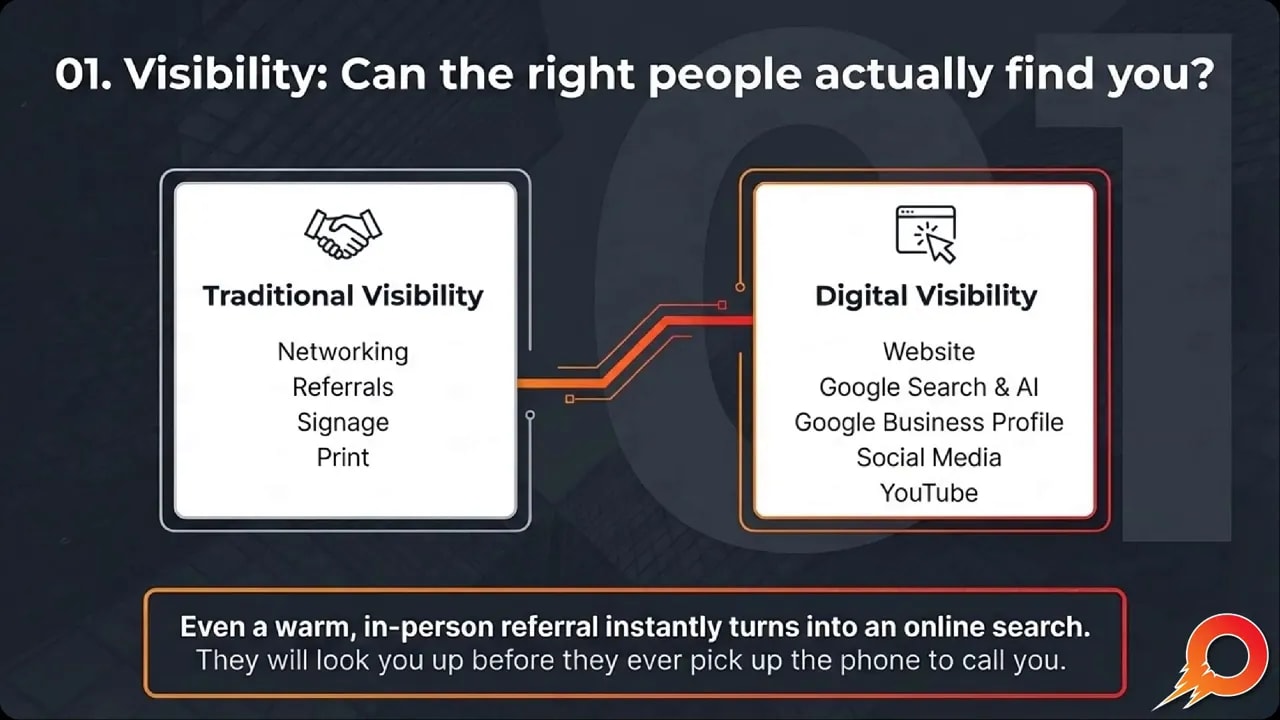
Traditional marketing still matters. Networking events still create relationships. Billboards still build awareness. Community sponsorships still get your name in front of people.
But here’s the twist: when someone hears about you, they almost always search online first.
If they can’t find you, or if what they find does not look credible and professional, you have already lost them.
2) Trust: Do They Believe You’re the Right Choice?
Visibility gets you noticed. Trust gets you chosen.
Once someone lands on your website or profile, they need a simple answer to the question every buyer is asking, whether they realize it or not:
Can I trust this person with my money?
Trust signals are things like:
- strong reviews
- case studies that show outcomes
- before and after photos (when relevant)
- clear guarantees and risk-reduction
3) Follow-up: Do You Stay Top of Mind?
Most small businesses lose 50 to 70 percent of potential sales simply because they do not stay in touch.
Someone shows interest. You send one email or make one follow-up call. They do not respond right away. Then you assume they are not interested and you move on.
But people do not buy when you are ready to sell. They buy when they are ready to buy.
So your job is not to chase instantly. It is to nurture consistently until they are ready.
📍 Visibility in the Age of AI: What Google and AI Actually Look At
When most business owners think about visibility, they think about one thing: rankings.
But AI-driven discovery and recommendation systems do not work the same way humans do. They still rely on your content and reputation signals, but they interpret your online presence differently than you might expect.
To build visibility that works in both traditional search and AI recommendations, focus on four critical layers.
1) Your Google Business Profile and Basic Online Presence
Your Google Business Profile is often the first “confirmation layer” a prospect checks. It is where they expect to find the essentials quickly: services, hours, location, contact details, and reviews.
If your profile is incomplete or inconsistent with your website, you create friction.
For deeper guidance on what to measure and how to avoid common issues, see:
2) Your Website Content and How It Answers Real Questions
Your website is not just a brochure. It is a question-answering machine.
Prospects land there to find clarity. What do you do? Who do you help? How do you do it? What results can you produce? What does the process look like?
If your website does not answer those questions clearly, you may still appear in search results, but you will struggle to convert traffic into leads.
If you want to strengthen your conversion foundation, this is a helpful starting point:
3) Your Authority Through Links and Mentions
Authority is basically proof that other reputable sources recognize you.
In plain language, it is the difference between:
- “We think we are good” and
- “Other people cite us and connect us to the topic.”
Authority signals can include links, mentions, and citations from relevant websites. This helps both search engines and AI systems understand where you fit.
4) Your Reviews and Reputation
Reviews are not just social proof for humans. They are a major trust and relevance signal for algorithms too.
In 2026, you should assume your reviews are part of how you are discovered, ranked, and recommended.
If you want to build a more proactive review strategy, explore:
- 6 easy ways to ask for customer reviews
- Online reputation management system
- Can reviews affect your SEO rankings
Get these four layers right, and you will rank higher in traditional search and improve your chances of being recommended by AI systems.
⭐ Trust Signals That Convert Browsers Into Buyers
Visibility is not enough. Even if someone finds you and checks your profile, they still need to feel safe choosing you.
Here’s what trust looks like in real buying behavior:
- They look for evidence you deliver results.
- They try to confirm you are legit and responsive.
- They look for clarity about what happens next.
If trust signals are missing, prospects hesitate. If trust signals feel vague or generic, they compare you to competitors who feel more specific and certain.
What Trust Content Should Include
Your goal is to remove risk and uncertainty. The best trust content usually includes:
- Specific reviews (not just star ratings)
- Case studies with context, challenges, and outcomes
- Proof of process (how you work, timeline, what’s included)
- Before and after examples where appropriate
- Guarantees or clear risk-reduction statements
How Humans and AI Read Reviews Differently
This is one of those insights that most business owners never hear.
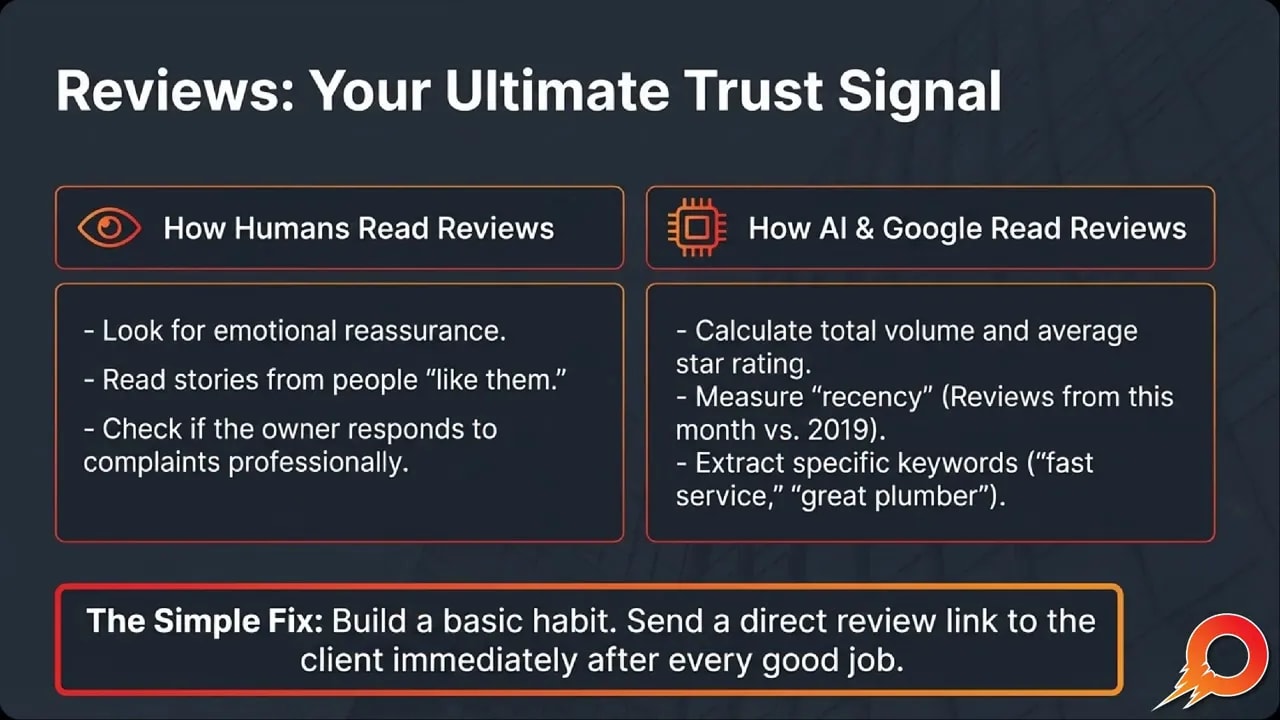
Humans read reviews looking for overall sentiment and recent experiences.
But AI reads reviews differently. It can analyze:
- keywords
- response rates
- review frequency
- specific details about your service
So a review that says “Great service, highly recommend” feels nice, but it may not provide the specific language your ideal customers search for.
The fix is surprisingly simple: ask your happiest customers for detailed reviews that mention specific services and results.
Try this approach when requesting feedback:
- What service did you book?
- What problem were you trying to solve?
- What did you notice after the work was done?
- Was the process easy and how was communication handled?
You are helping customers write the words your future customers and algorithms need.
📲 Follow-up: The Missing Gear That Costs You 50–70% of Sales
Follow-up is where most growth plans fall apart.
Not because business owners are lazy, but because follow-up is uncomfortable. It feels repetitive. It feels like “being salesy.” It also feels time-consuming, especially when you’re busy doing the actual work.
But the cost of not following up is huge.
When someone reaches out and you send one message and stop, you do not just lose that one lead. You train the market to associate you with a short, incomplete conversation.
A better strategy is to nurture leads through a system that matches how buying decisions actually happen.
People buy when they are ready, not when you want them to.
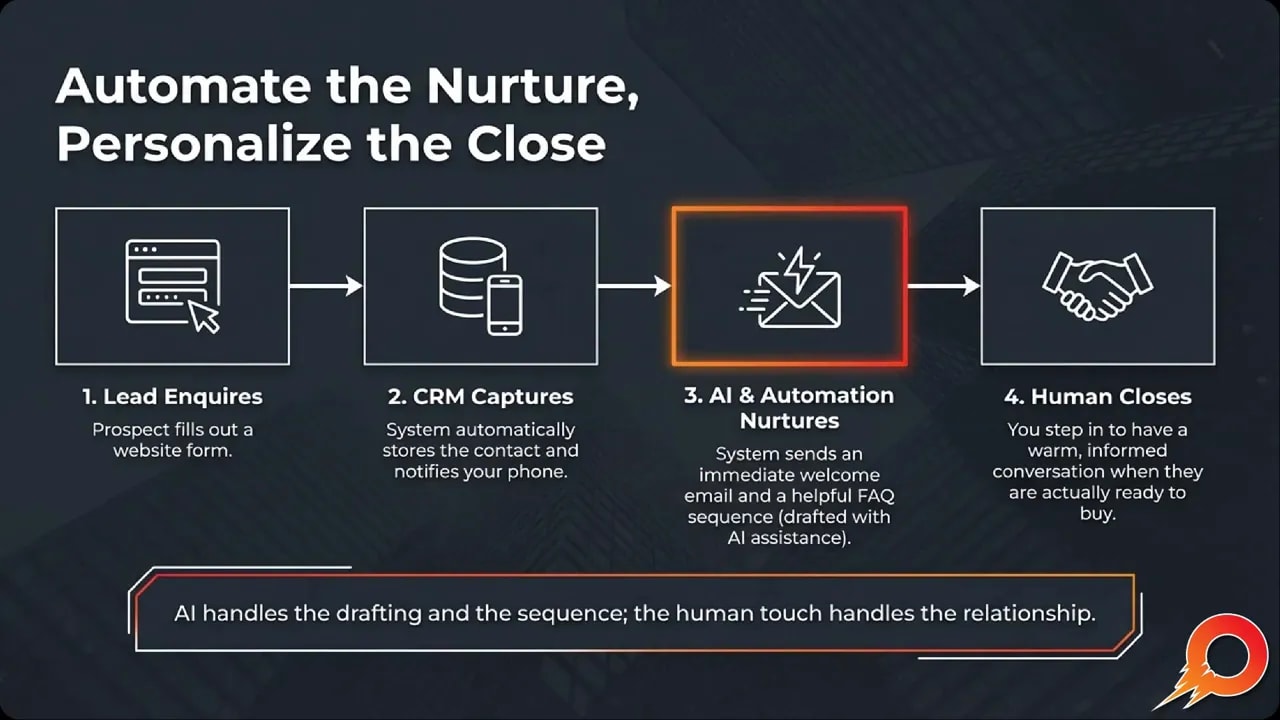
A 4-Step Automated Nurturing System
Instead of relying on willpower, use a consistent, automated follow-up sequence that feels personal.
The system is four parts:
- Instant response when someone reaches out.
- Educational content that builds value over time.
- Smart automation that stays relevant and feels like a real conversation.
- Human involvement exactly when prospects are ready.
AI can handle the consistent touchpoints, but you still close the deal when someone is clearly moving toward a decision.
What “Feels Personal” Actually Means
Automation does not have to feel robotic. Personal follow-up usually comes from doing two things well:
- Use the right triggers and content for the right prospect stage.
- Write like you talk, not like you sell.
For example, instant response should confirm the next step and set expectations. Educational emails should answer the real doubts people have before they book. Then human follow-up should be short, specific, and focused on the final decision.
If you want to improve your email follow-up performance, you may also find this useful:
- https://www.outsourcedmarketing.ca/is-your-email-list-dead/
- https://www.outsourcedmarketing.ca/increase-customer-retention-email/
- https://www.outsourcedmarketing.ca/how-to-reduce-your-unsubscribe-rate/
🧩 How the Flywheel Effect Works (And Why It Feels Like “Predictable Growth”)
When visibility, trust, and follow-up operate together, your marketing becomes a flywheel.
Each element strengthens the next:
- Visibility increases the number of people who find you.
- Trust increases the percentage who convert from visitors into leads.
- Follow-up increases the percentage of leads who actually become customers.
And because you are building systems, your efforts compound over time. You are no longer “hoping for business.” You are systematically generating it.
What This Means for Your Marketing Decisions
This framework changes how you evaluate your spending and activities.
Instead of asking, “Are we doing enough marketing?” ask:
- Does our online presence create instant credibility?
- Do our pages answer the questions buyers need answered?
- Do our reviews and reputation provide enough specific proof?
- Do we respond quickly and keep nurturing leads until they are ready?
That is the difference between random acts of marketing and a growth engine.
🧰 How to Know If You Need This (Trigger Phrases to Listen For)
Some businesses have time to experiment. Others have to solve growth constraints quickly.
If you recognize yourself in these phrases, it likely means one (or more) of the gears is not working:
- “I need more customers.”
- “I’m not getting enough leads.”
- “People don’t know we exist.”
- “I’m too busy to do marketing.”
- “I don’t understand digital marketing.”
These are not blame statements. They are clues.
Often the business owner is focusing on the craft, which is good. The problem is that the customer journey requires marketing systems behind the scenes.
📊 A Practical Checklist: Quick Wins for Each Gear
If you want a fast starting point, use this checklist to identify where you can improve without overhauling everything at once.
Visibility quick wins
- Update your Google Business Profile with accurate services, hours, and contact details.
- Make sure your website has clear pages that answer buyer questions (not vague marketing copy).
- Ensure your name, address, and phone number are consistent across directories.
- Track what your online presence looks like when someone searches your business name.
Trust quick wins
- Request detailed reviews that mention the specific service and outcomes.
- Add case studies that show the “before problem” and “after results.”
- Use before and after visuals when your industry can support it.
- Clarify guarantees, timelines, and process steps.
Follow-up quick wins
- Set up an instant response for new inquiries.
- Create a short educational follow-up email sequence that builds value.
- Automate follow-up so leads do not fall through the cracks.
- Define when a human should take over so closing feels natural, not forced.
🧠 Elevate Your Growth With Strategic Marketing (Not Random Marketing)
If you feel like you’re doing “all the marketing” but results are inconsistent, you’re probably doing the wrong kind of marketing.
The framework here is systematic. It prioritizes the customer journey and the modern discovery behavior shaped by Google and AI.
That means the real win is building a total online presence that improves over time, paired with trust assets and follow-up automation that recovers missed opportunities.
If you want to go deeper on specific parts of this system, here are a few relevant guides from the Outsourced Marketing blog:
- https://www.outsourcedmarketing.ca/small-business-needs-digital-marketing/ (Why digital marketing is not optional)
- https://www.outsourcedmarketing.ca/marketing-services/total-online-presence-audit/ (Deep audit approach for visibility and conversion)
- https://www.outsourcedmarketing.ca/reviews-testimonials-recommendations/ (Reviews, testimonials, recommendations)
- https://www.outsourcedmarketing.ca/build-marketing-plan/ (How to build a marketing plan that actually drives growth)
- https://www.outsourcedmarketing.ca/most-important-seo-metrics-to-track/ (What to measure so you can improve what matters)
🎁 Free Visibility, Trust, and Follow-up Checkup
If growth is frustrating and you want clarity fast, a structured audit can save months of guessing.
A strong checkup typically reviews your marketing across all three gears. It helps you understand:
- Where you are losing potential customers
- What is holding back visibility and rankings
- What trust signals are missing or underperforming
- Where leads are slipping away due to slow or inconsistent follow-up
For those who want to take action, you can explore the free marketing checkup resources here:
- https://www.outsourcedmarketing.ca/free-marketing-checkup-form/
- https://www.outsourcedmarketing.ca/contact-us/
❓ FAQ
How do I know whether my problem is visibility, trust, or follow-up?
A quick diagnostic: if people never contact you, visibility may be the issue (they cannot find you or your presence looks weak). If people contact you but hesitate or do not book, trust is likely weak (reviews, case studies, and clarity are missing). If people request info but you never close, follow-up is probably failing (slow response, no nurturing sequence, or inconsistent touchpoints).
Do reviews matter for AI and search engines, not just humans?
Yes. Reviews function as both social proof and algorithmic signals. AI can analyze keywords, review frequency, and service-specific details. That is why detailed reviews that mention your actual services and outcomes tend to outperform vague “great service” feedback.
What does “instant response” mean for follow-up?
Instant response means you acknowledge inquiries immediately (or within minutes) so prospects feel seen and supported. The goal is to confirm receipt, set expectations, and deliver the next step so you do not lose momentum.
Can automation replace human sales conversations?
No. Automation should nurture consistently, answer questions over time, and keep leads moving forward. Then you step in when prospects are ready to make a decision. That is how automation increases efficiency without feeling impersonal.
How long does it take to see growth from this three-gear approach?
Some improvements appear quickly, especially if you fix instant follow-up and update key trust assets. Visibility improvements through SEO and online reputation typically compound over weeks to months. The flywheel effect accelerates when visibility, trust, and follow-up are all working together.
Is this only for online-first businesses?
Not at all. Local service businesses, trades, and established professionals benefit massively because discovery is digital even when service delivery is local. If people search you online to confirm details, you need visibility, trust, and follow-up.
Want help fixing the broken gear? We can diagnose what’s limiting your growth—visibility, trust, or follow-up—and recommend the fastest improvements to start converting more of the leads you already generate. Book a free checkup or contact us to get started.
SCHEDULE A COMPLIMENTARY STRATEGY SESSION
Ask your marketing questions, get expert answers, book your free session now!