
Transform Your Strategy: Repetition Engine for Social Media
Table of Contents
Boost Your Business with The Repetition Engine Social Media Strategy
If you run a local business, you already know the challenge: create content, stay consistent, generate results, and prove your value — all while managing daily operations and serving your customers.
Here is the honest truth that most social media advice glosses over: the single most powerful thing you can do for your business on social media is not to go viral. It is to show up the same way, in the same place, saying the same core message — over and over again.
That is the foundation of what I call The Repetition Engine.
What Is the Repetition Engine?
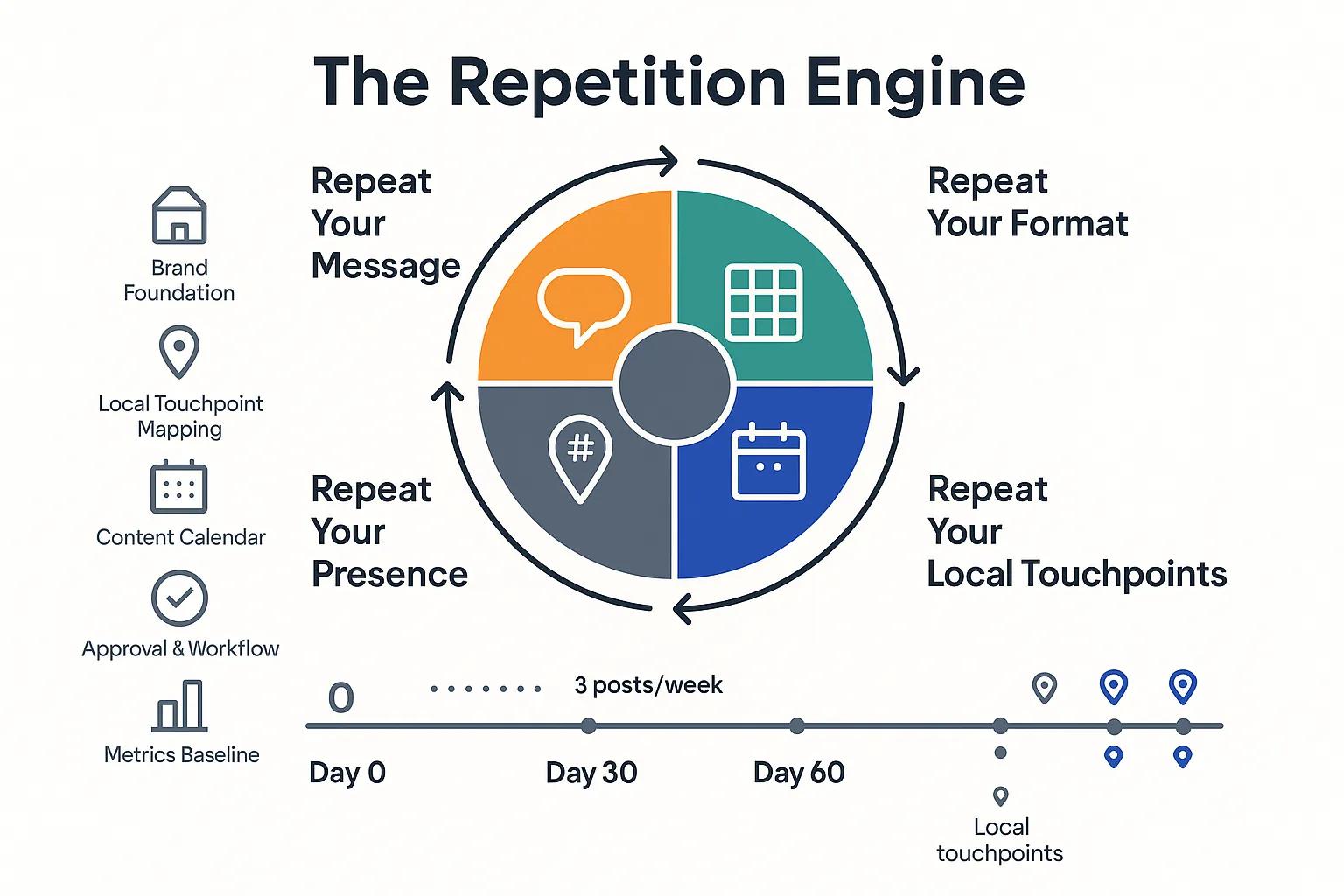
The Repetition Engine is a strategic social media framework built on four principles that compound over time to make your brand memorable, trustworthy, and top of mind in your local community.
The four principles are:
- Repeat your message — consistency in what you say reinforces your brand’s positioning
- Repeat your format — when people know what to expect, they are more likely to engage
- Repeat your presence — regular posting builds familiarity and trust
- Repeat your local touchpoints — keep showing up in the same community contexts
Each principle on its own has value. Together, they create something far more powerful than any one-off campaign.
Principle 1: Repeat Your Message
The biggest mistake small businesses make on social media is trying to say everything. One week you might post about your services. The next, an inspirational quote. Then a team photo. Then a sale. None of it connects.
Your brand positioning is built through repetition. When you pick one core message and reinforce it consistently, your audience starts to associate your business with that idea.
Real-world example: A dental clinic in Barrie wants to be known as the family dentist who makes kids feel safe. Every piece of content — from patient stories to behind-the-scenes posts — ties back to that positioning. After 90 days of consistent messaging, that clinic owns that identity in the minds of their local audience. A competitor posting general dental tips never builds the same mental real estate.
Key takeaway: Your job is to define the one core message for your business and protect it fiercely. Every post should either reinforce it directly or support it contextually.

Principle 2: Repeat Your Format
Humans are pattern-recognition machines. When your audience knows what is coming, they engage more readily. A recognizable format lowers the cognitive barrier to consumption.
This is why podcasts have signature intros, news shows have familiar structures, and the best Instagram accounts have a consistent visual grid. Format is a trust signal.
Real-world example: A local law firm in Newmarket runs a weekly “Legal Myth vs. Fact” post every Tuesday. Followers begin to anticipate it. The format — bold headline, two-sentence myth, two-sentence fact, call to action — is identical every week. The content changes; the format does not. Over six months, that post series becomes the most-engaged content in their account history.
Practical formats for your business:
- Monday motivation tied to your core message
- Weekly tip or how-to in a consistent visual template
- Friday client spotlight or review feature
- Monthly community involvement post
- Recurring question-and-answer series
Key takeaway: Build a content calendar that rotates through 3 to 5 repeating formats. You will spend less time deciding what to post, and your audience will engage more because the pattern feels familiar.

Principle 3: Repeat Your Presence
Consistency of posting frequency is not just good practice — it is a trust signal. A business that posts regularly feels operational, engaged, and trustworthy. A business with long gaps feels uncertain, even if those gaps are just gaps in the content calendar.
This matters especially for local service businesses where trust is the primary buying factor. A restaurant that posts three times a week feels more alive than one that posts in bursts. A contractor who shows their work every week feels more reliable than one who disappears for a month.
Real-world example: A plumbing and HVAC contractor in Bradford posted only when they had promotions — roughly once or twice a month. When they shifted to a consistent three-posts-per-week schedule with a mix of educational tips, project photos, and community posts, their Google Business Profile views increased by 41% within 60 days. The content was not dramatically different. The presence was.
Algorithms on Facebook, Instagram, and LinkedIn also reward accounts that post consistently over accounts that post sporadically. Regular presence means regular reach.
Key takeaway: Build repeating schedules into your social media plan. Consistency compounds. Sporadic effort dissipates.

Principle 4: Repeat Your Local Touchpoints
This is the principle most national marketing playbooks ignore — and it is the one that makes local business social media genuinely powerful.
Local touchpoints are the community contexts that your audience recognizes and shares: the local street, the school, the farmers market, the annual fair, the neighborhood hashtag, the regional news topic.
When your business shows up in those contexts repeatedly, it stops feeling like advertising and starts feeling like community membership. That is an entirely different level of trust.
Six specific local touchpoint tactics you can use:
- Tag local landmarks and neighborhoods in every relevant post — the community park, the main street, the business district
- Reference local events as they happen: the town festival, the minor hockey playoffs, the school fundraiser
- Collaborate with complementary local businesses in posts — tag the local florist when your restaurant uses their centerpieces
- Celebrate local milestones — the town’s anniversary, a local athlete’s win, a community award
- Use local hashtags consistently — build a short stack of 3 to 5 hyper-local hashtags that appear on every post
- Feature local customers with permission — a photo of a satisfied client in front of their recognizable home or business location signals community roots
Real-world example: A family restaurant in Bradford began tagging every post with #BradfordON, featuring photos taken with recognizable local landmarks in the background, and collaborating on posts with two neighboring businesses. Within 90 days, their Instagram reach doubled — almost entirely from local accounts who shared the posts organically. No paid advertising. Pure local resonance.

The Compounding Effect: Why the Repetition Engine Works Over Time
Think of the Repetition Engine the way you would think about compound interest.
In the first 30 days, the results feel modest. You are posting consistently, your message is clear, your format is recognizable, and you are showing up in local contexts. But your audience is still learning who you are.
By day 60, something shifts. Followers start engaging more readily because the format is familiar. The algorithm begins rewarding the consistent posting cadence. Local community members start tagging your business in posts because they associate your brand with community.
By day 90, the flywheel is turning on its own. Content gets reshared. Followers recommend your business to friends. Your brand occupies a distinct position in the local mental map. New leads reference social posts in their first conversation.
This is the flywheel effect: each revolution builds on the last, and the effort required to maintain momentum decreases as the compounding takes hold.
Businesses that abandon social media before the 90-day mark never experience this. They see modest results in the first few weeks and conclude that social media does not work. What they have actually experienced is the pre-compounding phase — the period where inputs are high and outputs are modest. Persist past that point, and the returns accelerate.
Your job is to hold the line during those first 90 days and understand why.

The Repetition Engine in Practice: A Small Business Checklist
Use this checklist to apply the Repetition Engine framework to your social media efforts.
Brand Foundation
- Define the single core positioning message for your business
- Identify the 3 to 5 content formats you will rotate through
- Build a brand voice guide: tone words, language to use, language to avoid
- Gather 20 to 30 approved brand photos for the first month of content
Local Touchpoint Mapping
- List 5 to 10 local landmarks, neighborhoods, or community contexts relevant to your business
- Build a local hashtag stack (3 to 5 hyper-local hashtags)
- Identify 3 to 5 complementary local businesses for potential collaboration posts
- Note upcoming local events in the next 90 days
Content Calendar
- Build a 30-day content calendar with repeating format slots
- Schedule a minimum of 3 posts per week
- Ensure each post connects to your core positioning message
- Include at least 2 local touchpoint posts per week
Approval and Workflow
- Establish a weekly or biweekly content approval cadence if working with a team or marketing partner
- Set expectations: consistency over perfection, posting schedule is non-negotiable
- Plan a 90-day review point to assess compounding results
Metrics Baseline
- Record baseline follower counts across all active platforms
- Note current Google Business Profile view and click metrics
- Establish 90-day targets: engagement rate, reach growth, local share rate
FAQ
How long before I see results from the Repetition Engine? Most small businesses begin to see measurable engagement improvement between 45 and 60 days. The compounding effect becomes clearly visible by 90 days. Set this expectation for yourself to avoid early frustration.
What if I want to change my core message frequently? This is a common challenge. Understand that repositioning resets the clock. Consistency in message is not a limitation — it is the mechanism by which the engine builds power. Think of it like compound interest: withdrawing early eliminates the accumulated growth.
How many platforms should my business be active on? For most local businesses, one to two platforms done consistently outperforms three to four platforms done sporadically. Choose where your ideal customers actually spend time, then apply the Repetition Engine there before expanding.
Can the Repetition Engine work for service businesses with limited visual content? Yes. Text-based formats, educational tips, and client testimonials all work effectively within this framework. The format consistency matters more than the content type. Even a service business with no photography budget can build engagement through a consistent weekly insight post.
Build Momentum That Lasts
The Repetition Engine is not a shortcut. It is the opposite of a shortcut — it is a systematic commitment to showing up the same way, in the same place, saying the same thing, until your brand becomes genuinely unforgettable in your local market.
This framework gives you something rare: a methodology you can understand, apply, and defend. When you wonder why results take time, you have an answer. When you feel tempted to change course after 30 days, you have the data and the framework to hold the line.
The businesses that win on local social media are not the ones with the biggest budgets or the most creative posts. They are the ones that showed up consistently long enough for the flywheel to start turning.
Start the engine. Keep it running.
Ready to build a social media system that compounds?
Book a discovery call with Outsourced Marketing Inc. and let us build a Repetition Engine for your business. Schedule a discovery call to get started.