The Local SEO Playbook – Your Guide to Local Rankings
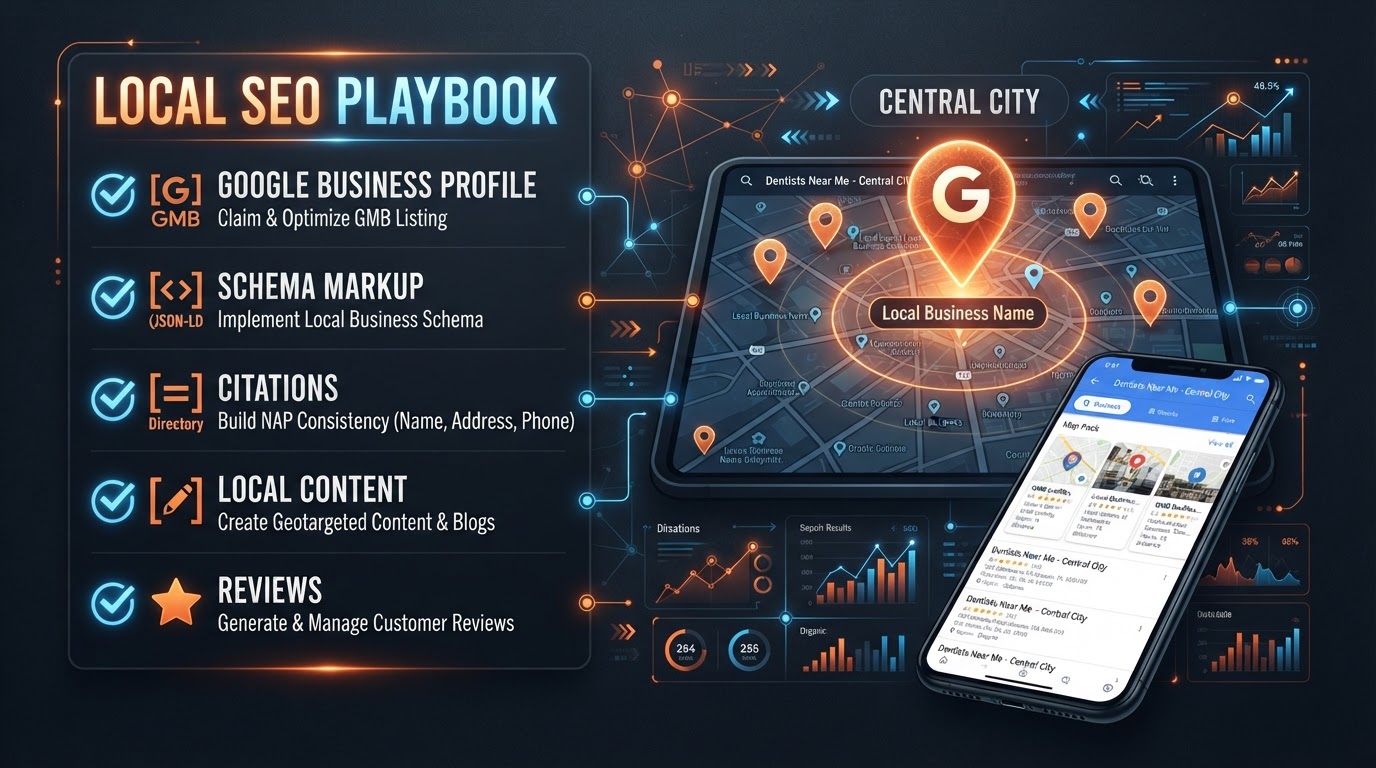
Updated August 19, 2026 — Local SEO remains the most powerful lead generation channel for local businesses. Google Business Profile (formerly Google My Business) is still the #1 ranking factor. The five pillars in this playbook remain unchanged, but execution has evolved with AI-powered search and increased mobile usage.
The Local SEO Playbook — Your Guide to Local Rankings
If you don't rank well locally for the things people are searching for, marketing will be a lot harder and a lot more expensive. Here's the good news — focus on these five elements and you can expect great results from local SEO and search. (The competitiveness of your industry may dictate your ultimate results.)
1. Optimize Your Google Business Profile
Google has a bit of a naming crisis when it comes to their local directory listings, but for now, you must pay attention to, claim, and optimize your Google Business Profile listing.
If this is news to you, go immediately to Google's Free Business Listing page and find out if you can claim your current listing.
Once you claim the right listing you need to make sure you take full advantage of all of the real estate and linking options available to you. This, by the way, is essential if your business is to ever show up in the coveted Google Local Pack for local searches.
Make sure you have the right business category and subcategories chosen for your business. Make note of the exact way your business name, address and phone number (NAP) appear. Whatever you show listed as the NAP on your Google Business Profile, you'll want to use consistently on your own website and across all directories.
2. Get Your Schema Markup Right
Search engines are busy trying to adopt a consistent markup protocol to help use HTML code to properly identify things like businesses, reviews, addresses, books, movies and the like. You can learn about the current popular markup for local businesses by visiting Schema.org.
Using proper markup for your address is kind of like handing Google your business card on a silver platter. It doesn't look like anything to the naked eye, but Google spiders can be 100% certain what they are looking at when it comes to identifying an address on your web pages.
The good news is that you don't really need to know anything about the underlying code to get this part right. Simply visit Schema.org's Local Business NAP generator and fill in the blanks — the tool will produce the HTML code you need to add to your site in place of your current address.
3. Clean Up Your Citations
You might be familiar with a few directories like Yelp and Google Local, but you probably didn't realize that Google relies on hundreds of data aggregators and directories to help them sort out and keep straight all of the local businesses out there.
Getting your listing straight on Google is essential, but if you've moved, or changed your phone, or just listed your details in all sorts of ways in business filings or Chamber directories, there's a good chance Google isn't sure which listing is correct and that's not a good thing.
Use a tool like MozLocal and see just how bad this problem is for your business. Once you determine there are a few inaccurate, inconsistent and incomplete listings use MozLocal, BrightLocal, WhiteSpark or Yext to clean listings and suppress inaccurate duplicates.
This step alone can do more for your local listings than any other aspect of local SEO.
4. Create Local SEO Content
This one should be obvious but it kind of isn't. When you create a brochure and hand it to a prospect, they pretty much know that you work in their city. But when you create content online, you need to go over and above to spell out where you do your work.
Now, it's easy to get spammy listing lots of local content and that can hurt you as much as help you, but you certainly should talk about where you work and in some cases have specific pages with case studies for specific trade areas, suburbs, and neighborhoods.
Don't forget to blog and post about local events and happenings. Using your blog to talk about community, customer, and employee related local news is a great way to spice up your local content in very authentic ways.
5. Focus on Reviews
Reviews have become another important form of content. As the statistics suggest, people increasingly rely on reviews to make decisions about the products and services they purchase. So, while you need positive reviews for social proof, you also need them as a pillar of your local SEO efforts.
Google factors review activity as one of the elements that helps determine what businesses show up in the Local Pack. You must have at least 5 reviews for Google to display the review stars as a highlighting feature of local results — that alone makes it important to acquire reviews.
Reviews are harder to get than they should be. Even a business with raving fans must work to get those reviews from happy customers. The key is to ask often and make it as easy as possible for your happy customers to log in to the sites that matter and leave a review. Check out our Review Funnel System to automate this process.
Take some time and make each of the five steps above a priority for your local business and you may find that local leads drawn from organic search can become your most potent lead generation channel.
FAQ
What is the most important factor for local SEO rankings?
According to multiple local SEO ranking factor studies, the top factors are: (1) Google Business Profile optimization (including accurate categories, complete information, and regular posts), (2) review quantity, recency, and keyword relevance, (3) consistent NAP citations across the web, (4) on-page SEO with local keywords, and (5) backlink quality and relevance. Proximity to the searcher is also a major factor Google considers.
How do I fix inconsistent business citations?
First, audit your citations using a tool like MozLocal, BrightLocal, or Whitespark to identify all listings and inconsistencies. Then: (1) Claim and correct all major listings (Google Business Profile, Yelp, Facebook, Bing Places), (2) Use a citation service to distribute consistent NAP data to dozens of directories at once, (3) Remove or merge duplicate listings, and (4) Ensure your website's NAP matches exactly. Consistency is key — even small variations like "St." vs "Street" can cause problems.
How many reviews do I need to rank in the Google Local Pack?
There's no magic number, but you need at least 5 reviews for Google to display star ratings in search results. Businesses with 40+ reviews see significantly higher click-through rates. For competitive local markets, 50-100+ reviews may be needed. However, review recency matters too — a steady stream of new reviews signals to Google that your business is active. Aim for a consistent review generation strategy rather than a one-time push.
How long does local SEO take to show results?
For most local businesses, you'll see initial improvements within 3-6 months of implementing a comprehensive local SEO strategy. Competitive markets may take 6-12 months. The timeline depends on your starting point, industry competitiveness, and how consistently you execute. Google Business Profile optimization and citation cleanup can show results fastest (1-3 months), while content creation and review building compound over time.

Duct Tape Marketing Master Certified Consultant & AI Search Expert.
View Ian's Expert Profile & Credentials →