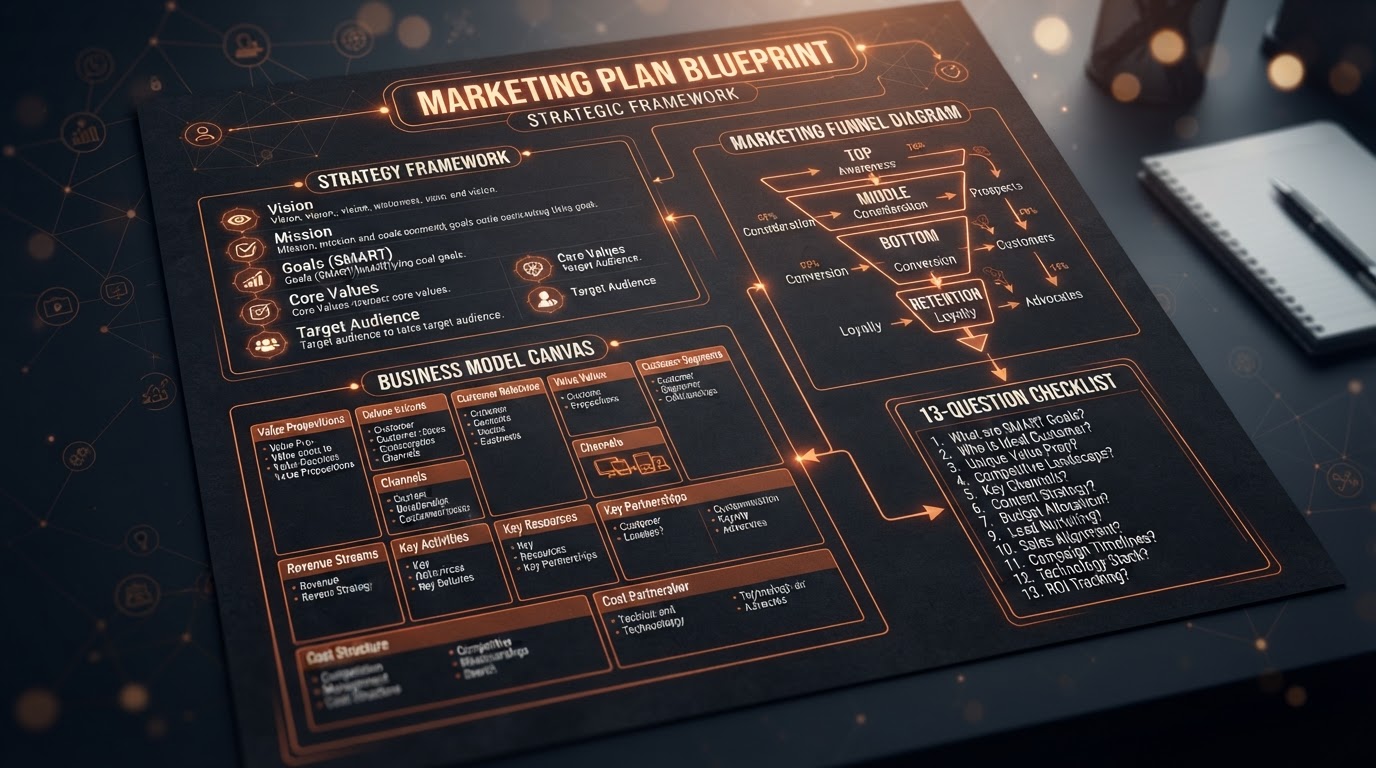
Updated August 19, 2026 — The 13 questions below remain the best starting point for building a marketing strategy. Originally authored by John Jantsch of Duct Tape Marketing, these questions cut through the noise and get to the core of what makes a marketing plan work.
13 Questions That Will Lead You To Your Perfect Marketing Strategy
By John Jantsch
Plenty of startups try to determine the perfect business model to take to market only to find that the market doesn't need, want or understand what they are presenting.
The fact is most books or courses on business models take this into consideration by suggesting trial and error scenarios and market hypotheses prior to launch.
Any business model, or plan for that matter, is little more than a guess and I believe that your best chance for getting that guess right is to build your business model based on a marketing strategy.
This assumes the role a fully developed marketing strategy actually should play in determining the direction of an organization. The fact is most people, if they consider marketing strategy at all, stop at a core message, identity elements and perhaps a sales proposition and call it a strategy.
A marketing strategy is how you plan to use the resources available to you to build an ongoing case that your business, products and services are the obvious choice for a narrowly defined ideal customer.
If you accept this expanded view of marketing strategy then I would suggest you answer the following questions in an attempt to measure where your strategy stands today and where it could go if you understood and integrated it fully as your business model:
- What about this job, work, or organization are you passionate about?
- How does this business serve a higher purpose for you and your customers?
- What value do you really bring that benefits your market in ways that your competitors wouldn't dream of proposing?
- What's the dominant personality trait that you need your customers to associate with your business?
- What does an ideal client look like?
- What is the simple 10-word core message that explains and excites?
- How will your market become aware of your business?
- How will your market come to trust that you have the answers?
- What are the revenue sources that you can tap to grow this business?
- Can you describe the perfect customer experience throughout your organization?
- What resource gaps and constraints do you need to overcome to achieve your strategy?
- What partnerships do you need to create in order to achieve your strategy?
- What would the result of using this strategy model to run your business look like?
How The Perfect Marketing Plan Would Work
Depending upon who you ask a marketing plan is either a necessary evil or tremendous waste of time. — That's such a shame, but I think I've finally come to understand why this is.
A well crafted marketing plan should be one of the most important strategic steps a business takes, but there's a disconnect. Marketing plans get created, but never used because, once put to paper, they don't easily relate to the real life experience of a business. They get created but never installed.
At a minimum your marketing plan should include:
- A description of your ideal customer
- Your core message (vs competitors)
- Your key marketing strategy
- Your communications tools
- Your lead generation plan (advertising, public relations, referral)
- Your web plan (yes, with a blog)
- Your lead conversion plan
- Your customer loyalty plan
- Your marketing calendar
- Your marketing budget
- Your key strategic indicators
- Scads of sales, revenue and profit projections
Now, the creation of the above is a great start and a beneficial exercise for any business, new or existing, but here's what's needed to truly make your marketing plan work.
Your marketing must have a life and the only way it can do that is if you throw it into the middle of your day to day business. As a document it's a fantasy and it stops breathing the minute you open the door each day. A truly effective marketing plan must integrate into the reality of the stuff you do each day.
Here's how the perfect marketing plan would work.
You create the plan as prescribed above, you bake the appropriate elements of your plan into your CRM system, you tie the plan to your actual sales, you flow the plan projections into your bookkeeping software and you circulate actual results through your key indicators, automatically updating your projections. Now that would make a living, breathing powerhouse of a marketing plan and, now, your marketing plan would actually run your business. (As it should be.)
These two posts were compiled to help you in your pursuit of the perfect marketing plan to propel your business towards achieving your goals. To read more from the founder of Duct Tape Marketing and award winning author John Jantsch, visit his blog at ducttapemarketing.com/blog.
Ready to build your marketing plan? Book a discovery call with our team and let's create a strategy that drives real results.
FAQ
What should be included in a marketing plan?
A complete marketing plan includes: (1) A description of your ideal customer, (2) Your core differentiating message vs competitors, (3) Your key marketing strategy, (4) Your communications tools and channels, (5) Your lead generation plan (advertising, PR, referrals), (6) Your web plan including blog content, (7) Your lead conversion process, (8) Your customer loyalty and retention plan, (9) A marketing calendar with monthly themes and activities, (10) Your marketing budget, (11) Key performance indicators to track, and (12) Sales, revenue, and profit projections.
How often should I update my marketing plan?
Review and update your marketing plan quarterly at minimum. Markets change, competitors adapt, and customer preferences shift. A quarterly review lets you assess what's working, reallocate budget from underperforming channels, and adjust your strategy. Do a comprehensive annual review to evaluate whether your overall strategy is still right for the coming year. The key is treating your marketing plan as a living document — not something you create once and file away.
What's the difference between a marketing strategy and a marketing plan?
Your marketing strategy defines WHO you're targeting, WHAT makes you different, and WHY customers should choose you. It's the foundation. Your marketing plan defines HOW you'll execute that strategy — the specific tactics, channels, timeline, budget, and metrics. Strategy comes first and informs the plan. A great plan built on a weak strategy will fail. A great strategy without a plan will never be executed. You need both, in that order.
How do I identify my ideal customer for my marketing plan?
Start by analyzing your best existing customers — the ones who pay on time, refer others, and are profitable to serve. Look for patterns in their demographics (age, location, industry, revenue) and psychographics (values, priorities, pain points). Then answer: What problem do they have that you solve better than anyone? What are they willing to pay for? Where do they go for information? The more narrowly you define your ideal customer, the more effective your marketing will be. "Everyone" is not a target market.

Duct Tape Marketing Master Certified Consultant & AI Search Expert.
View Ian's Expert Profile & Credentials →